
Commercial fire door closers
Commercial fire door closers
Commercial fire door closers are essential to life safety in multi-occupancy and public buildings. For architects working in social housing and healthcare (particularly care homes and mental health facilities) the closer you specify must do more than shut a door.
It must ensure reliable compartmentation, reduce ligature risks, resist vandalism, preserve design intent, and remain compliant over the building’s life.
Here we explain why concealed fire door closers outperform traditional overhead devices, and how to specify with confidence.
Understanding the role of fire door closers in commercial buildings
What are commercial fire door closers?
A fire door closer is a controlled mechanical device that ensures a door returns to the closed position after use and latches positively. In a fire, that closed-and-latched position preserves compartment lines to contain heat, smoke, and toxic gases.
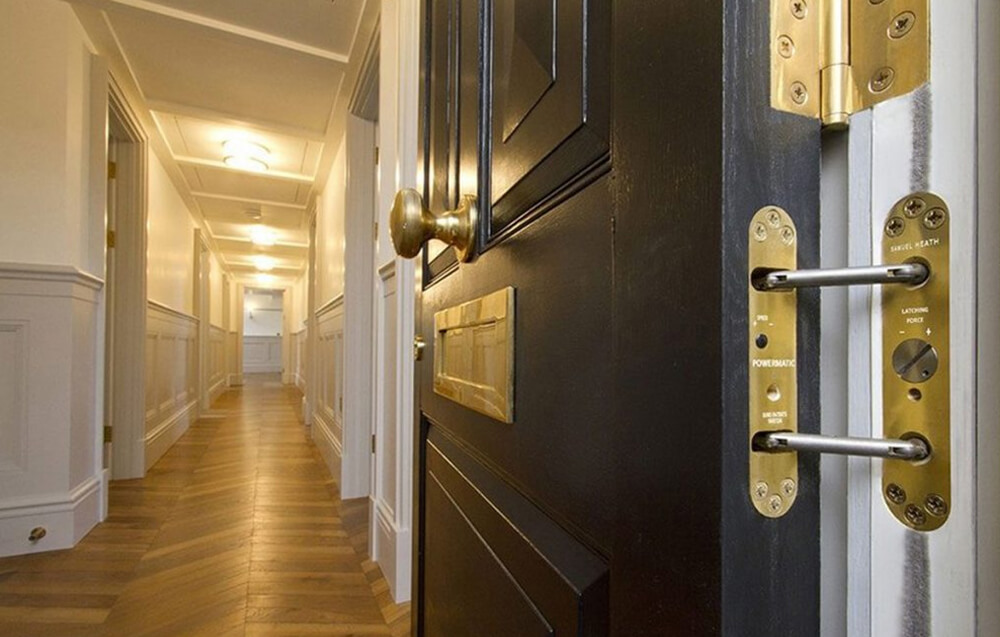
Traditional overhead closers mount on the door leaf and frame with a projecting arm. Concealed fire door closers sit within the door and frame, with no external hardware visible when the door is closed and minimal visibility when open.
Why automatic door closing is critical for fire safety
Compartmentation only works if doors shut fully and reliably. Automatic closing removes human error, producing a consistent seal at the leaf, frame, and threshold so smoke and flame cannot bypass the assembly. This keeps escape routes serviceable for longer, supports firefighter access, and preserves structural integrity by slowing fire spread.
Where commercial fire door closers are used
Closers are mandatory or strongly recommended across social housing, care homes, hospitals, mental health facilities, hotels, education, and mixed-use commercial buildings. In these environments, doors are high-traffic, user capability varies, and operational disruption carries a safety and cost penalty—so the choice of closer matters.

The evolution from overhead to concealed fire door closers
Overcoming the limitations of overhead door closers
Overhead devices have well-documented drawbacks in sensitive sectors. They present potential ligature points that raise serious risk in mental health and other clinical settings. They are visible and easily accessible, so suffer vandalism and misuse in social housing, leading to unsafe doors and repeat replacement costs. Their institutional look conflicts with therapeutic, homely interiors, and they can trap dirt, complicating hygiene regimes.
How concealed fire door closers improve safety and design
Concealed closers remove ligature opportunity by eliminating exposed arms and mounting at a low, hidden position. Being out of sight, they are less likely to attract interference, reducing damage, downtime, and cost. The concealed format preserves clean lines demanded by contemporary and heritage projects alike, helping architects deliver non-institutional environments that support wellbeing. With no horizontal arms, concealed closers also minimise dust and bacterial accumulation and are easier to inspect and clean at low level.
Key benefits of concealed commercial fire door closers
Improved safety and compliance
Well-engineered concealed closers are designed and tested to return doors to a fully closed and latched state in a controlled manner. Compliance with BS EN 1154 confirms controlled performance; successful fire door assembly testing to BS EN 1634-1 confirms suitability for FD30/FD60 applications. Where relevant, BS 476 testing may be included for legacy specifications. CE and UKCA conformity evidence that the product meets applicable regulatory requirements in the EU and UK respectively.
Aesthetics and architectural integrity
Concealed hardware maintains the visual intent of corridors, apartment entries, resident rooms, and clinical suites. In conservation and heritage contexts, concealed solutions avoid intrusive surface plates and arms that would compromise period detailing or prove impractical on arched or non-standard openings.
Durability and reduced maintenance
Premium concealed closers undergo rigorous endurance cycling—commonly in excess of 500,000 cycles—to verify long-term reliability. By reducing vandalism and accidental impact damage, concealed devices lower reactive maintenance and the consequential risk of non-compliant, non-operational fire doors.
Hygiene and wellbeing considerations
Hidden mechanisms reduce surfaces that accumulate detritus, supporting infection control policies in healthcare and improving cleanliness in social housing. The resulting non-institutional aesthetic contributes positively to occupant comfort and recovery.
Performance standards and regulations for commercial fire door closers
Relevant standards and certifications
- BS EN 1154 – performance requirements for controlled door closing devices, including closing speed, power, and durability.
- BS EN 1634-1 – fire resistance testing of door assemblies with hardware, confirming suitability for FD30/FD60 applications.
- BS 476 – fire tests on building materials and structures (applicable in some legacy or supplementary contexts).
- CE marking / UKCA marking – conformity with EU/UK regulatory frameworks.
The importance of third-party certification (Certifire)
Certifire is a respected, independent third-party certification scheme for passive fire protection. Certification provides robust, traceable assurance of performance, with samples selected from production and tested at UKAS-accredited laboratories. For architects and clients, Certifire reduces risk in specification, procurement, and sign-off.

Choosing the right commercial fire door closer
Key specification considerations for architects
- Door geometry and mass – confirm power size and maximum leaf weight/width; verify suitability for latched and unlatched installations.
- Fire rating – ensure demonstrated performance on the intended door core and assembly for FD30/FD60 as required.
- Hinge compatibility – confirm integration with standard or concealed hinge systems (e.g. Tectus) where needed.
- Use profile – match endurance and adjustability to traffic levels and occupant needs.
- Environment – prioritise anti-ligature, hygiene, and anti-vandal features for social housing and healthcare.
Balancing safety, design, and cost-efficiency
Initial unit price should not drive closer selection. Overhead devices may appear cheaper, but repeated damage, unsafe doors, and full leaf replacement quickly exceed the whole-life cost of a high-quality concealed closer. In sensitive sectors, anti-ligature and anti-vandal benefits also carry clear risk reduction value.
The Powermatic R100 and R108 – leading concealed fire door closers from Samuel Heath
Powermatic R100
The Powermatic R100 is a jamb-mounted concealed fire door closer engineered for performance-led, design-sensitive applications. It is CE and UKCA marked, type tested to BS EN 1154 (power size 3), and approved to BS EN 1634-1 for use on FD30 and FD60 timber fire doors; it has also been tested to BS 476. The R100 is the only jamb-mounted concealed fire door closer with Certifire certification, offering independent third-party verification of fire performance. With anti-ligature advantages, resistance to vandalism, adjustable closing speed and power latching, endurance testing beyond 500,000 cycles, suitability for latched/unlatched installations, and compatibility with electronically powered hold-open devices, the R100 is a robust choice for social housing, care homes, hospitals, education, and hotels. A 10-year guarantee underpins whole-life value.
Powermatic Axis R108
The Powermatic Axis R108 is designed specifically for use with concealed hinge systems, including the Simonswerk Tectus range, aligning the closer’s pivot axis with the hinge geometry for smooth, predictable control. It is CE marked (EN 1154), fire tested to BS EN 1634-1 for FD30 and FD60 timber doors, suitable for doors up to 80 kg and 950 mm wide (EN 1154 size 3 test door 60 kg), and supports latched and unlatched applications. Where the design intent requires a fully concealed hinge-and-closer solution, the R108 delivers a cohesive, discreet installation.
Testing, quality, and assurance – Samuel Heath’s in-house excellence
Stringent in-house testing for long-term reliability
Samuel Heath manufactures and tests concealed door closers in-house to precise tolerances, exercising tight control over materials, machining, and assembly. Production samples undergo endurance cycling in excess of 500,000 open–close operations and functional checks at key stages to validate consistency against specification. Internal rigs mirror the methods of external laboratories, supporting continuous development and dependable output.
Why in-house testing matters to specifiers
For architects and clients, in-house capability means repeatable performance every time a product is specified. It reduces risk, accelerates technical support, and ensures that published data reflects real, current manufacture—vital for compliance, handover, and long-term asset management.
Applications of commercial fire door closers in key sectors
Social housing
Concealed closers directly address vandalism and misuse that compromise door integrity and resident safety. By removing obvious hardware, they reduce incidents that would otherwise force full door replacement and expose landlords to compliance and cost pressure. The result is safer buildings and lower whole-life cost.
Healthcare and mental health facilities
Anti-ligature design is a priority. Concealed closers remove exposed arms and high mounting points associated with suspension risk. Low visual impact supports non-institutional interiors shown to improve comfort and recovery. The concealed format also aligns with rigorous hygiene regimes.
Care homes and hotels
Guest and resident rooms benefit from discreet hardware that protects design intent while maintaining dependable, quiet door control. The concealed solution avoids intrusive components in compact rooms and narrow corridors, improving usability and perception of quality.
Education and commercial buildings
High-traffic doors demand durable, adjustable control that maintains compliance without frequent intervention. Concealed closers reduce tampering and accidental damage in busy environments, sustaining performance through term-time and beyond.
Specification guidance
Practical steps for compliant selection
- Confirm door core, leaf size, and intended rating (FD30/FD60) and select a closer with demonstrable BS EN 1634-1 performance on that construction.
- Verify BS EN 1154 power size, adjustability, and suitability for latched/unlatched conditions and any hold-open/door control interfaces.
- For mental health or similar settings, prioritise concealed, anti-ligature solutions and document the rationale in the fire strategy and risk assessment.
- For heritage or design-led interiors, prefer concealed solutions to protect the architectural concept and avoid impractical surface mountings.
- Record CE/UKCA conformity and, where available, third-party certification (e.g. Certifire) in the specification and O&M manuals.
Specifying commercial fire door closers with confidence
Why work with Samuel Heath
With over 60 years of engineered door control expertise, Samuel Heath designs, manufactures, and tests concealed fire door closers in the UK, supporting architects and main contractors with precise data, reliable logistics, and responsive technical guidance. The focus on in-house quality assurance, endurance testing, and third-party certification provides the performance evidence architects need for compliant, design-conscious specifications.
Speak to our experts
For technical guidance, NBS specification support, or help selecting the right concealed closer for social housing, care homes, mental health facilities, hospitals, education, or hotels, contact the Samuel Heath team. To review product details now, visit the Powermatic R100 and Powermatic Axis R108.
