
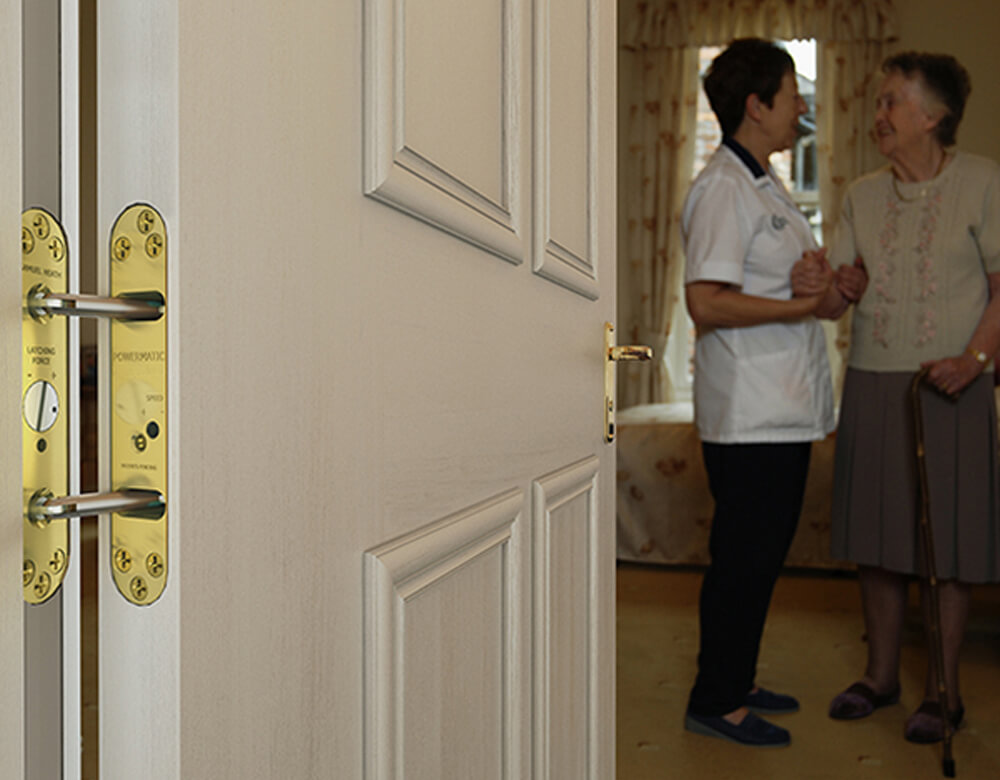
Fire rated door closers
Fire rated door closers
Fire rated door closers are installed in multi-occupancy buildings, education sites, healthcare facilities and commercial buildings to ensure that doors automatically close to contain the spread of smoke and fire in the event of a fire incident.
Your specification has to do three things well. First, it must deliver reliable compartmentation by ensuring a consistent close and positive latch on every cycle. Second, it must support a non-institutional aesthetic that promotes wellbeing. Third, it must stand up to day-to-day realities such as tampering, frequent use, pressure differentials from ventilation systems and the inevitable need for straightforward maintenance.
Concealed solutions meet these demands more effectively than surface-mounted alternatives and should be your default for high-risk residential settings.

Fire rated door closers
Traditional fire rated door closers are devices that are mounted on top of a door frame and connected to the door by a mechanical arm. When the door is released, spring tension makes it automatically close.
These overhead door closers spoil the aesthetics of rooms, and present certain risks and limitations. Samuel Heath has been designing concealed fire rated door closers, as an alternative to overhead door closers, for over fifty years. Our concealed fire rated door closers, that are hidden between the door and door frame, are now installed in buildings across the world.
Concealed fire rated door closers – the best choice
Why are concealed fire rated door closers the best choice for multi-occupancy and public building specifiers and facilities managers? Concealed fire rated door closers offer several benefits over traditional door closers.
Three top benefits of concealed fire rated door closers are:
- Concealed fire rated door closers are anti-ligature. The problem of overhead fire door closers as ligature points has received worldwide attention. Concealed fire rated door closers are hidden away, located much lower and completely invisible when the door is closed, so don’t present the same ligature risk.
- Overhead fire rated door closers are regularly subjected to vandalism or damage. Doors that automatically close can be a source of frustration, particularly for residents of social housing or high rise developments. As a result they are often deliberately damaged. Concealed door closers are far less accessible and don’t protrude as a reminder to residents of their irritation.
- Traditional, overhead fire rated door closers are synonymous with institutional settings. Homely interiors are known to be instrumental in enhancing comfort, wellbeing and recovery. Concealed fire rated door closers remove the institutional feel of a room to provide cosy living spaces while still meeting essential fire safety standards.
Fire rated door closers in mental health and social housing environments
For mental health and dementia care projects, concealed fire rated door closers address two critical risks. They remove obvious ligature points by eliminating exposed arms and brackets at height, and they reduce the likelihood of tampering because the mechanism sits within the door and frame.
This is not only a design decision but a clinical safety intervention that supports safer bedrooms, day rooms and staff-support areas. In social housing, the vandal resistance of concealed devices protects the fire strategy.
Visible overhead arms are a target for misuse and once damaged, doors fail to self-close, triggering non-compliance and reactive replacement of entire doorsets.
Concealment prevents casual interference and maintains performance through daily use.
Hygiene and maintenance
Hygiene matters too. Overhead hardware presents horizontal surfaces that collect dust and bacteria, which is unhelpful in clinical accommodation.
A concealed mechanism located at low level is simpler to inspect and clean and aligns with infection-control routines. These practicalities improve the resilience of your design in use.

Fire rated concealed door closer – Powermatic R100
The world-renowned fire rated concealed door closer from Samuel Heath is the Powermatic R100.
BS EN 1634-1 approved for use on one hour and half-hour fire doors, the Powermatic R100 is also the only Certifire approved, fire rated concealed door closer. This is an exclusive, independent accreditation from a third party company that confirms the high fire safety performance of the Powermatic R100.
Successfully type tested to BS EN 1154: 1997 power size 3, the Powermatic R100 is also BS 476 tested for one-hour and half-hour fire doors. Download the full Powermatic R100 specification here.
The Powermatic R100 is not for use with concealed hinges. For concealed hinge applications you will need the Powermatic Axis R108.
Fire rated concealed door closer – Powermatic R108
The Powermatic Axis R108 fire rated concealed door closer was exclusively designed for the Simonswerk’s Tectus concealed hinge system. The Powermatic R108 has a unique twin power mechanism, is BS EN 1634-1 fire tested for FD60 and FD30 timber doors, and suitable for latched and unlatched installations. Download the full Powermatic R108 specification here.

Samuel Heath – keeping buildings and people safe
Samuel Heath is based in the UK. We have been keeping buildings and people safe around the world for over five decades.
Are you specifying fire rated door closers for your project? Speak to Samuel Heath about our fire rated concealed door closer products and why they are now the best choice for industry standard fire safety.