
Residential fire door closers
Residential fire door closers
Residential fire door closers are an essential component of fire safety in multi-occupancy buildings such as social housing, care homes and healthcare facilities. For architects, choosing the right closer means more than meeting regulation.
It involves balancing safety, usability, aesthetics and cost-efficiency, while designing environments that are safe, compliant and welcoming.
Concealed fire door closers provide an advanced solution that overcomes many of the challenges associated with traditional overhead door closers.
Understanding residential fire door closers
A residential fire door closer is a controlled mechanical device that automatically closes a fire door after use. This action is crucial for maintaining compartmentation, preventing the spread of smoke and flames, and allowing occupants to evacuate safely.
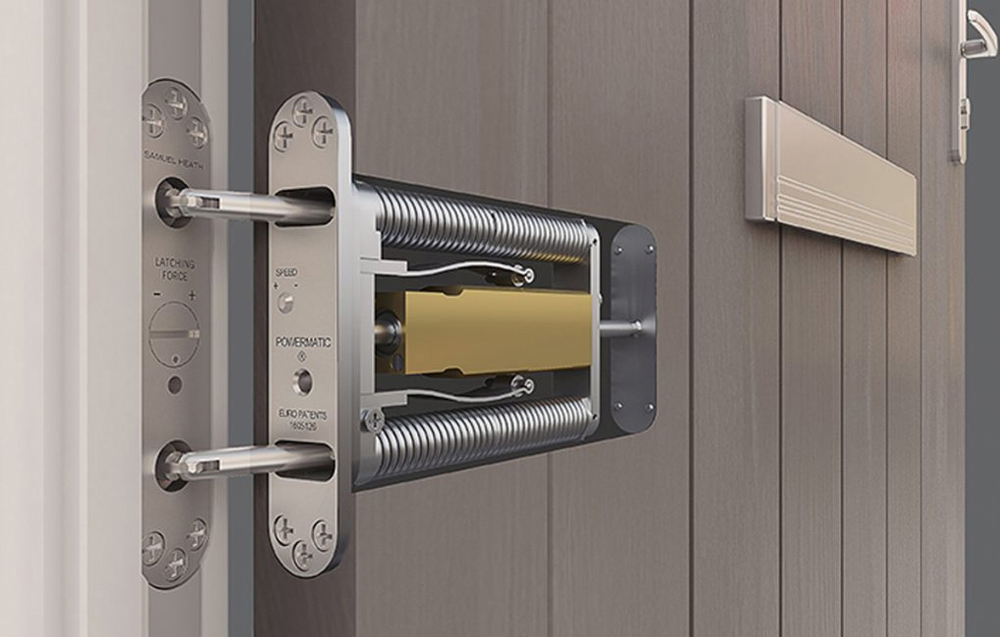
Traditional overhead door closers use a surface-mounted arm and mechanism that are visible on the door and frame. Concealed fire door closers, by contrast, are installed within the door leaf and frame, hidden from view when the door is closed and barely visible when open.
Their purpose and performance remain the same, but the concealed installation offers distinct advantages in residential settings.

Why fire door closers are essential in residential design
In residential and healthcare buildings, compartmentation is the foundation of fire safety.
Automatically closing fire doors limit the spread of smoke and heat, protecting escape routes and helping firefighters control an incident. However, the design and functionality of the closer also affect the user experience.
Residents, patients and staff need smooth and predictable door operation. A poorly chosen closer can make doors heavy, noisy or difficult to use, compromising both safety and accessibility.
Challenges of fire door specification in residential environments
Architects working on social housing and healthcare projects face specific challenges when specifying door closers. Overhead devices are often subject to vandalism in social housing where residents tamper with or remove them, viewing them as an inconvenience.
This leads to unsafe doors, non-compliance and costly maintenance. In mental health and care environments, overhead door closers present a ligature risk that must be eliminated to protect vulnerable occupants.
Beyond safety, visible mechanical arms contribute to an institutional aesthetic that architects strive to avoid when designing spaces intended to promote comfort and wellbeing.
Benefits of concealed residential fire door closers
Concealed fire door closers resolve these issues effectively. Installed discreetly within the door and frame, they offer a safer, more durable and visually unobtrusive alternative to overhead models. Concealed door closers provide several key benefits for residential projects.They enhance safety and compliance by ensuring the door closes in a controlled and consistent manner, meeting BS EN 1154 and BS EN 1634-1 standards for performance and fire resistance.
Both FD30 and FD60 fire door assemblies can incorporate concealed closers without compromising aesthetics or functionality. Concealed mechanisms are also anti-ligature by design, removing any potential suspension point and contributing to safer environments in mental health and healthcare settings. Their hidden position prevents tampering or vandalism, a frequent problem in social housing.Architecturally, concealed closers help create calm, homely environments that support wellbeing. They eliminate the visible hardware associated with institutional settings, maintaining clean lines in corridors, apartments and resident rooms. In care homes, this contributes to familiar, non-clinical surroundings that promote comfort and independence.
Durability is another significant advantage.
Concealed door closers undergo extensive endurance testing, often exceeding 500,000 cycles, to ensure long-term reliability. Their hidden location protects them from accidental or deliberate damage, reducing the frequency of repairs and replacements. Over time, this minimises maintenance costs for housing associations, contractors and facilities teams.

Performance standards and fire safety regulations
All residential fire door closers must comply with recognised standards to ensure consistent and safe performance.
BS EN 1154 defines the mechanical and operational requirements for controlled door closing devices, including adjustable speed, power and durability.
BS EN 1634-1 specifies fire resistance testing for door assemblies, verifying the closer’s suitability for FD30 and FD60 applications.
BS 476 covers additional fire testing for materials and assemblies.
In the UK and EU, CE and UKCA marks demonstrate conformity with relevant regulations and manufacturing quality. Architects should also look for third-party certification such as Certifire. This independent accreditation provides verified assurance of a product’s fire performance and confirms that ongoing manufacturing and testing processes are subject to regular external audit.
Choosing the right residential fire door closer
When selecting a residential fire door closer, architects should consider several factors beyond basic compliance. These include the door weight, leaf size and configuration, the level of usage, and the needs of building occupants.
or healthcare and social housing projects, durability, safety and accessibility are key priorities. Concealed fire door closers outperform overhead alternatives across all these metrics.
They are safer, more discreet, and less likely to be vandalised. They improve the look and feel of residential spaces while maintaining the highest level of fire safety. Over time, their reliability reduces total lifecycle costs, making them a cost-effective choice for both new build and refurbishment projects.
Samuel Heath concealed fire door closers for residential projects
Samuel Heath has been designing and manufacturing concealed door closers for over 60 years. Our products are engineered for performance, reliability and design integrity, and are used extensively in residential and healthcare buildings around the world.The Powermatic R100 concealed fire door closer is a jamb-mounted solution that is completely hidden when the door is closed. It is CE and UKCA marked, tested to BS EN 1154 and BS EN 1634-1, and approved for use on FD30 and FD60 timber fire doors. It is also the only concealed door closer with Certifire certification, offering verified, independent proof of fire performance.
The R100 is anti-ligature, vandal-resistant and adjustable for closing speed and latching action. It is suitable for latched and unlatched installations, can be used with electronically powered hold-open devices, and has been endurance tested to over 500,000 cycles. It comes with a 10-year guarantee.The Powermatic Axis R108 concealed fire door closer is designed for use with concealed hinge systems such as the Simonswerk Tectus range. It delivers smooth, controlled operation and aligns perfectly with modern design requirements for fully concealed door hardware.
The R108 is CE marked, fire tested to BS EN 1634-1 for FD30 and FD60 timber doors, and suitable for latched and unlatched installations. It provides architects with a refined, technically robust solution where concealed aesthetics and compliance are both essential.
Testing, quality assurance and reliability
Every Samuel Heath concealed door closer undergoes stringent in-house testing under controlled laboratory conditions. By maintaining full control over the manufacturing and testing process, we ensure consistent quality and performance across all products.
Our in-house test rigs replicate UKAS-accredited laboratory methods, allowing continuous monitoring, verification and improvement. This approach gives architects confidence that each product specified will perform exactly as expected.
Applications of residential fire door closers
Concealed fire door closers are widely specified in social housing developments to prevent vandalism and maintain compliance.
By removing visible hardware, they reduce damage and replacement costs, extending the lifespan of fire doors and maintaining building safety. In care homes and assisted living schemes, concealed closers contribute to safe, homely environments where residents feel comfortable.
In mental health and healthcare facilities, they provide essential anti-ligature protection without compromising fire safety or design intent. They are also suited to multi-residential developments, student accommodation and other high-occupancy dwellings, where durability and reliable performance are essential.
Specifying residential fire door closers with confidence
Architects can specify Samuel Heath concealed fire door closers with complete confidence. With over six decades of British engineering experience, Samuel Heath combines craftsmanship, technical expertise and rigorous quality assurance to deliver products that perform and last. Our concealed closers allow architects to design safer, more attractive residential buildings that comply with fire regulations and meet the needs of residents and facilities teams alike.
Speak to our experts
For technical guidance, NBS specification support, or help selecting the right concealed closer for social housing, care homes, mental health facilities, hospitals, education, or hotels, contact the Samuel Heath team. To review product details now, visit the Powermatic R100 and Powermatic Axis R108.
